

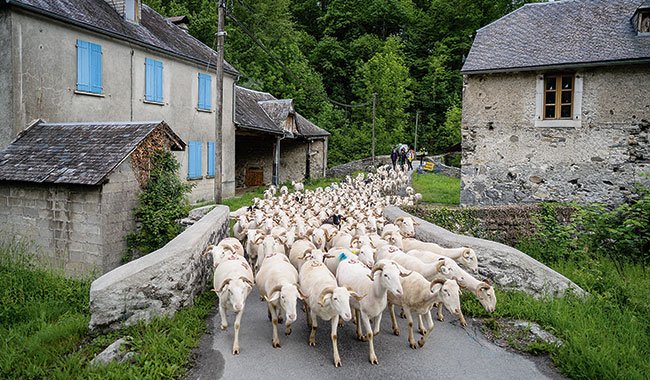
Have you ever watched how sheep behave over the course of their lives? They live on a farm their whole life long. They move about to feed on what their shepherd offers them. Most interestingly, they move in flocks. Theirs is a formidable collective movement. And they live that way until death, often brought about by the farmer, follows. All in all, the life of the sheep is as though programmed, and no surprise ever occurs. It may happen that it is sold to another owner, but the cycle of its life does not change for all that: the end is the same.
Now, have you ever watched how the majority of human beings behave over the course of a calendar year? They live, for the luckiest among them, in a house or an apartment. They move about to earn money. That money serves to feed them, to care for them or to procure the things of this world. Most interestingly, they follow the dates of the calendar without flinching, as though they had been the authors of it: in January, they hold great festivities on New Year’s Day; in February, they celebrate Valentine’s Day; in March, International Women’s Day, Ramadan and the solemnities of Easter; in April, Easter Monday; in May, Mother’s Day; in June, Father’s Day, and then we have just reached the half-way mark of the year. As if that were not enough, the same dynamic starts up again in July, September and then October, when we have Thanksgiving and Halloween; in November, it is Thanksgiving in the United States, and then we fall into December with the preparations for the year-end holidays before the arrival of Christmas and of New Year’s Eve.
On top of these statutory dates, we must add birthdays, the birthdays of those close to us, the birthdays of the people close to those close to us, and the independence days of the provinces or the states where each of us lives.
And every year, the same hand is dealt all over again!!
With a little distance, it is important to ask ourselves what sort of year we would want to live:
Would we want to live a life modelled on a timetable predefined by others, long before us, people who clearly do not have the same priorities as we do, and that until the end of our days?
Or, on the contrary, would we want to live a thrilling and successful year with a calendar we have drawn up for ourselves and that truly and intrinsically answers our priorities of the moment?
From the outset, it must be acknowledged that not following the crowd carries its share of risks. Depending on the environment, it may be seen as a sign of deviance or of revolt. Some would even speak ofsocial abnormality.
The aim is not to refuse the established order and to be a person out of step with the societal mass. It is, in any event, to live according to a calendar of goals one has set for oneself.
Besides, we must understand that what is being proposed here is nothing extraordinary, for a good many shrewd individuals, whose names you cite with amazement and admiration, already live by this concept. Here, then, are five (5) steps to living a successful year aligned with your true self:
1- Make a very long list of everything you wish to own, accomplish, obtain, achieve, forget, leave behind, or everything you are thinking of giving up.
2- Rank, in order of priority, everything you have listed.
3- Make a shorter list of what goes into a "DOABLE" column and what goes into a "NOT DOABLE" column.
4- Forget everything that appears in the "NOT DOABLE" category, for it is liable to cost you time and energy only to deliver no result at all in the end.
5- Apply the SMART method to the goals you have kept. This method was devised by Peter Drucker and it is frequently used to help a person define goals that are achievable and realistic:
a- S for Specific : this means being as precise as possible. You want to learn English? Perfect. But be precise: how many hours of class per week? Is there software or are there books to buy? Why learn English? A career or a trip in view?
b- M for Measurable : you must be able to check whether the result has been reached. For that, the goal must be measurable: cutting tobacco consumption down to two cigarettes a day, spending one evening with the family during the week, writing one page in English every week, and so on.
c- A for Attainable : you want to lose 15 kilos in a month? Here is a goal that is not attainable and is liable to bring on discouragement, loss of motivation and loss of self-confidence. The goal has to be spread over a reasonable period.
d- R for Realistic : fairly similar to the previous condition, this means moving forward step by step and persevering. You want to become world Sumo champion, yet you are 45 years old and do not weigh 75 kilos; let us say that the realistic aspect is hardly being taken into account.
e- T for Time : and this is where we come back to our calendar for the year. It is very important to set oneself dates. Without a timegoal, you will drift through the tumultuous waters of the year, like the sheep, never remembering that a goal is to be pursued and accomplished, and then acted upon.
From the year of the sheep to the year of your own goals, there is but one step. It is up to you to take it or to ignore it.
M. Z.
Comments