

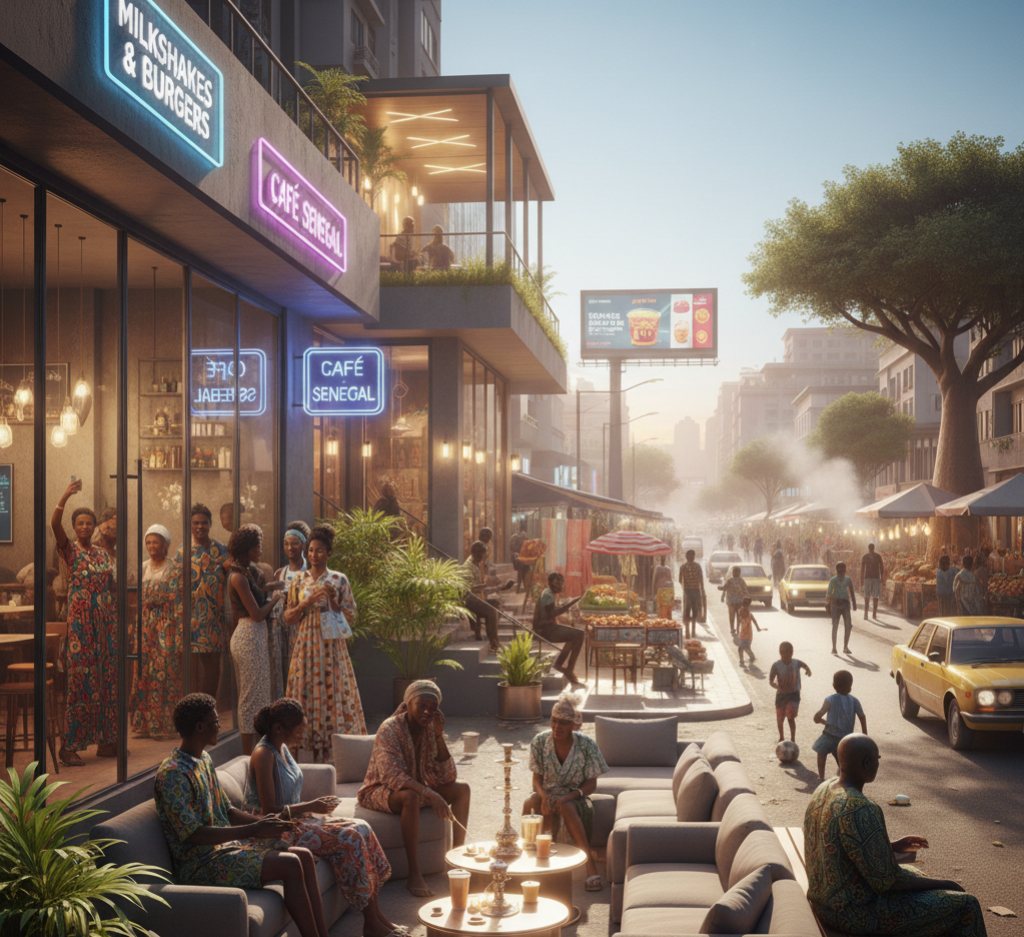
Picture yourself in Dakar, Abidjan or Accra: modern bars washed in neon, stylish lounges, coffee shops where milkshakes and burgers are served alongside local dishes. In Yaoundé, Lomé or Cotonou, the same Western codes invite themselves into the urban landscape. To a Western traveller, these cities sometimes bear a startling resemblance to Paris, New York or Seoul. But to the people who live there, this is local modernity, their way of living “in the world’s fashion.” It is a quiet unease, rarely said out loud: that of discovering, thousands of kilometres from home, forms of leisure that look exactly like the ones you left behind.
A phenomenon I would like, from now on, to call: cloned leisure.
In this context, the question arises: what is left of the change of scenery, of the one-of-a-kind experience, when you go on holiday in Africa? Such is the paradox of contemporary leisure: global in its inspiration, local in its adaptation, yet at times so standardized that it erodes the very appeal of travel.
Play is everywhere in human life. From childhood on, toys are our first tools for learning, discovery and entertainment. In adulthood, that playful dimension persists: we look for places and activities, often paid ones, that offer us experiences through which we can learn, escape and socialize. To this universality of play a geographical dimension is added. Leisure varies from one region of the world to another: in the West, indoor activities dominate because of the climate, whereas in Africa, outdoor leisure holds centre stage. It is this diversity that has long nourished the very idea of a holiday: leaving your familiar surroundings to discover what you cannot experience at home.
For several decades now, globalization has been redrawing these differences. Often described through an economic or technological lens, it works just as powerfully as a cultural vector. Models of entertainment, forms of consumption and urban aesthetics spread quickly on a global scale, carried by the major economic poles known as the expanded Triad: North America, Western Europe and East Asia. These regions export their codes and their models, which deeply shape the way African cities conceive of and consume leisure.
In African cities, this influence sometimes takes the form of a direct import, sometimes that of a local adaptation of global trends. Dakar, for instance, is watching lounges inspired by Dubai or Paris blossom, where the indoor atmosphere wins out over the traditional terrace. Abidjan is multiplying restaurants with Westernized menus in the neighbourhoods of Cocody and Marcory. Accra has acquired coffee shops, rooftops and fast-food outlets that reproduce the codes of North American capitals almost exactly. In Yaoundé, modernized storefronts are spreading along the main arteries, while in Lomé and Cotonou those same thoroughfares now host cosmopolitan establishments where burgers, milkshakes and neon coexist with a few local touches. This hybridization — glocalization — blends international modernity with elements of the local soil, yet it remains intimately bound to the foreign models that inspire it.
The question then becomes: does this glocalization enrich what is on offer or, on the contrary, reduce the singularity of local experiences? Because in practice, even glocalized, these spaces remain very close to the ones you find in Montreal, Paris or New York. A visitor arriving from the West may therefore be taken aback to discover that in Africa people eat burgers in neon-lit settings and frequent lounges with cosmopolitan codes — so many practices he already knows at home, sometimes in a more varied or more accomplished form.
We established it above: if we leave Canada, the United States, France and the other Western countries to go on holiday in Africa, for instance, it is to live the experiences of the place, to do the activities of the country, to take our pleasure the African way. Yet it must be said that the models for a night out in Africa closely resemble what we already find in our Western surroundings: indoor bars, VIP bars, restaurants with Western meals, vendors of “doughnuts” and “bubble tea”, fast-food joints for burgers, chicken thighs and chicken wings, the famous “chicken wings”, and so on. We can agree that these activities and these meals have their origins in globalization, or in exported culture.
And so, when a visitor from Europe or North America simply suggests going for a cold beer by the beach, outdoors, under the sun, the idea may be received as “cheap”, as a lack of effort or a refusal to spend. Yet the frame of reference is not the same: locals aspire to live what they imagine to be an imported modernity, while the visitor from the West is seeking precisely the simple pleasures of the land, the ones he misses day to day. This mismatch of expectations illustrates a paradox: if Africa’s big cities offer experiences very close to those of Western metropolises, where then does the change of scenery lie? Why invest thousands of dollars to relive abroad what you can already do at home, sometimes at lower cost and with greater variety?
In time, the globalization of the games, leisure and pleasure industry will kill Africans’ desire to holiday in Africa. Indeed, if you have to spend $2,000 on plane tickets whose prices never stop climbing in order to go and do the very things you already do in the West, you might as well go, for less, down South or to other countries of the expanded Triad which, on reflection, have nonetheless held on to priceless tourist riches and experiences that are one of a kind. Besides, not one of the seven wonders of the modern world is in Africa.
And yet Africa remains a continent of exceptional tourist wealth: magnificent landscapes, unique biodiversity, living traditions, thousand-year-old cultures, varied cuisines, renowned hospitality. These aspects largely escape standardization. But in urban spaces, which capture a significant share of travellers, the gradual standardization of leisure can weaken the specificity of the African experience.
In a world where work and the search for security dominate daily life, a holiday is a precious chance to break with the ordinary: setting aside time to disconnect, in order to preserve oneself, has become almost compulsory. But when leisure becomes standardized on a global scale — even in its glocalized form — the promise of a change of scenery fades. The challenge for African societies is not to give up modernity, nor to reject global trends, but to preserve a form of singularity in the way they play. To design genuinely rooted experiences, able to offer an authentic alternative to international uniformity. The question of whether a holiday in Africa is still worth it, once argued only on the ground of costly airfares, now arises over the very variety of the activities to be had during the trip. Could seeing family members then become the sole engine of these journeys? For if, tomorrow, travel to Africa rests on nothing but family reunions, for want of a distinctive offering of things to do, it is the whole tourism dynamic that risks growing fragile. Preserving the identity of leisure is no small detail: it is central to maintaining the value, the meaning and the appeal of a stay on the continent.
M. Z.
Comments